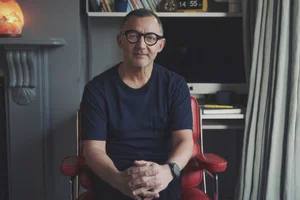
Performance is fragile. Expression isn't.
I spent forty years performing. Then I learned to let my breath carry the sound, and understood the difference.
Hello fellow traveller,
For most of my life, I performed.
I don't mean on a stage. I mean in boardrooms, in meetings, in the way I walked into a room. I had a version of myself I could deploy, polished and convincing, and I was very good at it. It got me to the top of companies. It sat across the table from billionaires and held its own. From the outside it looked like confidence. From the inside it was something else: a performance I had to keep delivering, because if I stopped, I wasn't sure what was left.
Here's what I've learned since. Performance is fragile. Expression isn't. And most high achievers have built their whole life on the wrong one.
The final frontier
A while ago I flew to Ibiza to see Michael, a client who's become a friend. He took me to a gathering of the most beautiful people, singers, most of them, talking about connecting to emotion and deeper levels of expression. It got round to me, and I had to be honest. I said I'd thought dancing in public without a drink inside me was my final frontier. It turned out singing was far worse.
They laughed, and the space softened, and it became one of the safest, most non-judgmental rooms I've ever been in. The man holding it was called Joseph, who lives in the woods in Sweden. I didn't know it then, but I'd just met the person who would open the next door.
Because on the Camino this May, I set myself a new outrageous goal: to sing in public, and to love the process no matter how bad the performance. And when the time came, I knew exactly who to call.
The night I sang
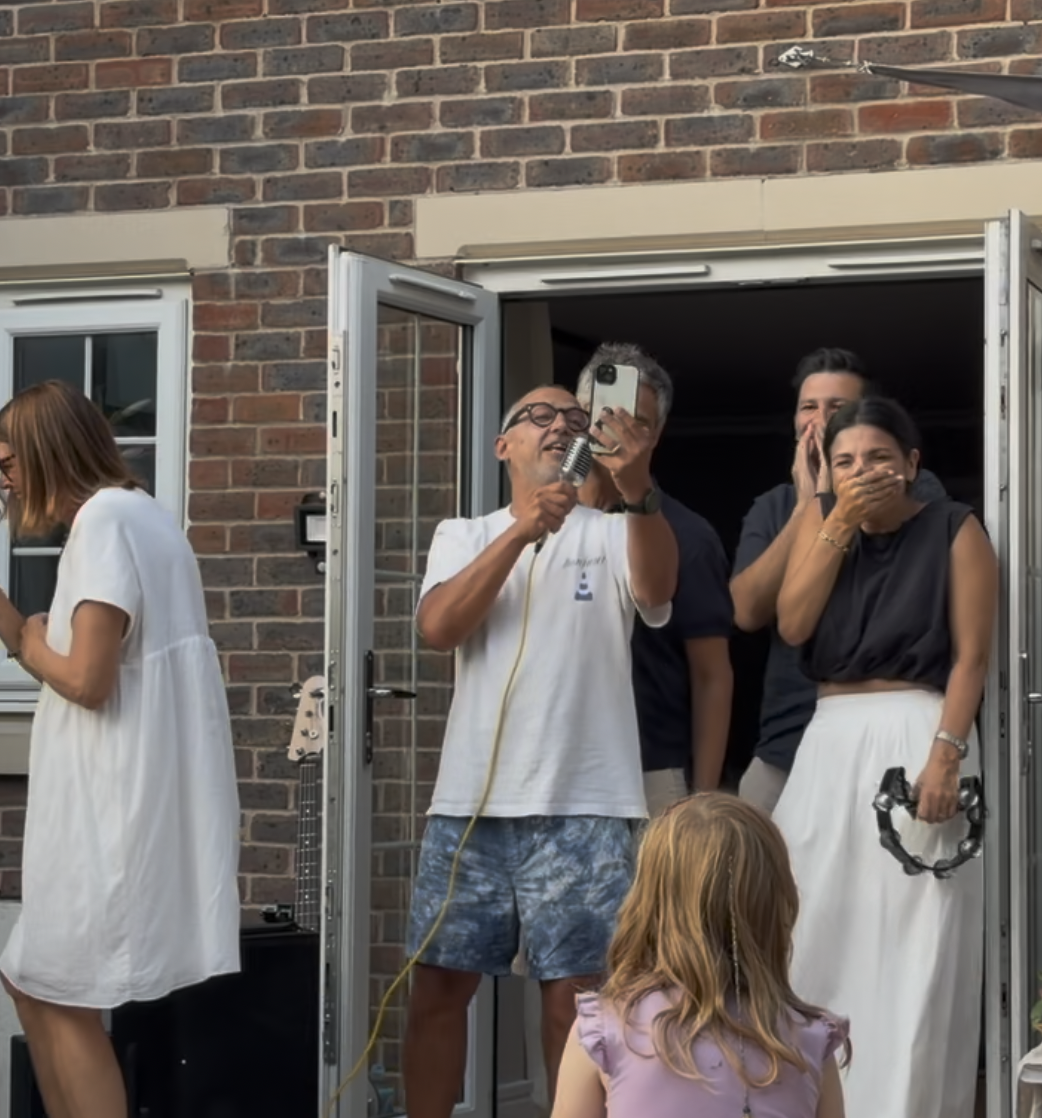
A few weeks ago, at my twin brother's house, I sang in public for the first time in my life.
Neither of us had ever done it and I had no idea the opportunity was going to present itself. We're the two most self-conscious people you could imagine when it comes to that sort of thing, it's the opposite of everything our lives had been. My daughter told me that if I didn't do it, I'd regret it. And I knew, the moment she said it, that she was right, because underneath the resistance was a real desire to do the thing.
So I stood up and I sang. Badly, probably, and I genuinely don't care. Because I wasn't performing. I was expressing. I wasn't trying to be good. I was trying to feel joy, and I did, and you can see it on my face in the photo.
Here's the strange part. I'd had exactly one session with Joseph by then. We hadn't rehearsed a single song. He'd shown me one thing.
The light bulb
I've meditated for the best part of twenty years. I thought I was aware. I could put my attention on any cell in my body and feel it light up. I genuinely believed there was nothing left to notice.
And then Joseph showed me the connection between breath and sound, and I realised I'd missed something that had been there my whole life.
My breath and my voice were completely disconnected. I'd never once thought of the breath as the thing that carries the sound. Obvious, when you say it. The vocal cords are moved by air. But I'd never felt it. What he showed me was simple: take a breath in, hold at the top, and let the sound rise, carried entirely by the breath from start to finish. When the breath ends, the sound ends. That's it. That's the whole thing.
And suddenly it was easy. It just flowed. The sound wasn't something I had to produce and defend. It was something the breath carried out of me, from wherever in the body it wanted to emerge, however it wanted to emerge.
That's expression. It isn't made. It's allowed.
Twenty years of awareness, and I'd been aware of everything except the breath carrying the sound. One session, and I was singing in public. That's how close these things sit to the surface, waiting.
Three levels
Between us, Joseph and I have mapped something that I think reaches far beyond singing.
There are three levels to any expression.
The first is pure expression. The body says what it needs to say, carried out on the breath. No editing, no strategy, just the thing itself, emerging. A child does this before the world teaches them not to.
The second is intentional play. You're still connected, still honest, but now you're consciously shaping it. Choosing to bring more warmth, more calm, more energy. Using expression as a tool, deliberately, while staying true to what's underneath. This is craft, and it's beautiful, because the connection is still there.
The third is performance for others. And this is where it goes wrong. Here you've disconnected entirely. You're not expressing anything real, you're delivering what you think will land, what will impress, what will protect you. It can look flawless. It often does. But it's saying nothing about you, because you've left the building.
That third level was most of my career, although I absolutely tasted the joy of expression at times.
Why one is fragile and one isn't
Here's the thing about performance. It depends on an audience, on approval, on getting it right. It can be judged, and so it can fail. Every performance carries the quiet terror of being found out. That's why so many successful people are exhausted and anxious underneath: they've built an identity on something that can be taken from them at any moment, by a bad quarter, a lost deal, a room that doesn't respond.
Expression can't fail, because it isn't trying to succeed. It isn't for anyone. It's just true. Nobody can tell you that you expressed yourself wrongly. There's nothing to defend, because you're not claiming anything except that this is what's real for me right now.
When you build a life on performance, you're only ever as secure as your last result. When you build it on expression, the ground doesn't move.
What this actually means
I'm not saying stop being excellent. The intentional-play level, the craft, is where a great deal of good work lives, and I wouldn't give it up. What I'm saying is: check what's underneath it. Are you shaping something real, or are you performing something hollow because you've lost contact with what's real?
Because you can feel the difference. Performance leaves you drained and slightly false, even when it goes well. Expression leaves you more yourself, even when it's messy. One takes energy. The other gives it.
I performed for forty years and it nearly emptied me out. Then I stood up at my brother's house and sang, badly, joyfully, carried by nothing more than my own breath, and felt more like myself than I had in decades.
I've no idea where this door leads. That's rather the point. The more I open, the more I discover.
Where in your life are you performing when you could be expressing?
Best,
Hugh
You've lived many versions of yourself in this lifetime. And there are many more still to come.
If you've built a life that looks right from the outside and feels like a performance from the inside, that's exactly the ground we'd cover together. Let's have a conversation.
P.S. My brother sang too. Afterwards he said he couldn't believe I'd made him do it. His son told me later what moved him wasn't the singing, it was watching the two of us, who'd never done anything like it, do it together. That's expression. Nobody was performing. That's why it landed.